
Adopting a Maintenance Mindset: School Gardens
Aligning the Growing Season with the Academic Year
Over the past 6 months, I’ve found myself returning to the same conversation with school garden coordinators – again and again – how do we recruit students, parents, teachers, and neighbors to take care of the school garden in the summer?
Recruiting students, families, and teachers is challenging enough during the school year. Asking overscheduled families and tired teachers to take on garden maintenance during the summer months often feels like an impossible ask.
What I’m questioning is whether summer production should be the goal at all for school gardens.
What if, instead of trying to grow high-maintenance annual crops through the hottest and most drought-prone months of the year – when school is out and routines disappear – we designed school gardens to rest in the summer? What if summer became a season for cover crops and soil building, flowers and pollinator support, and perennial plants, while traditional food production happened primarily in fall, winter, and spring?
As I explored this idea further, I found I wasn’t alone. Nearly a decade ago, Kristine Hahn of the Michigan State University Extension described intentionally avoiding the summer maintenance challenge by focusing on cool-season crops grown while school is in session. Her approach echoed what I was beginning to suspect: the problem may not be participation – it may be design.
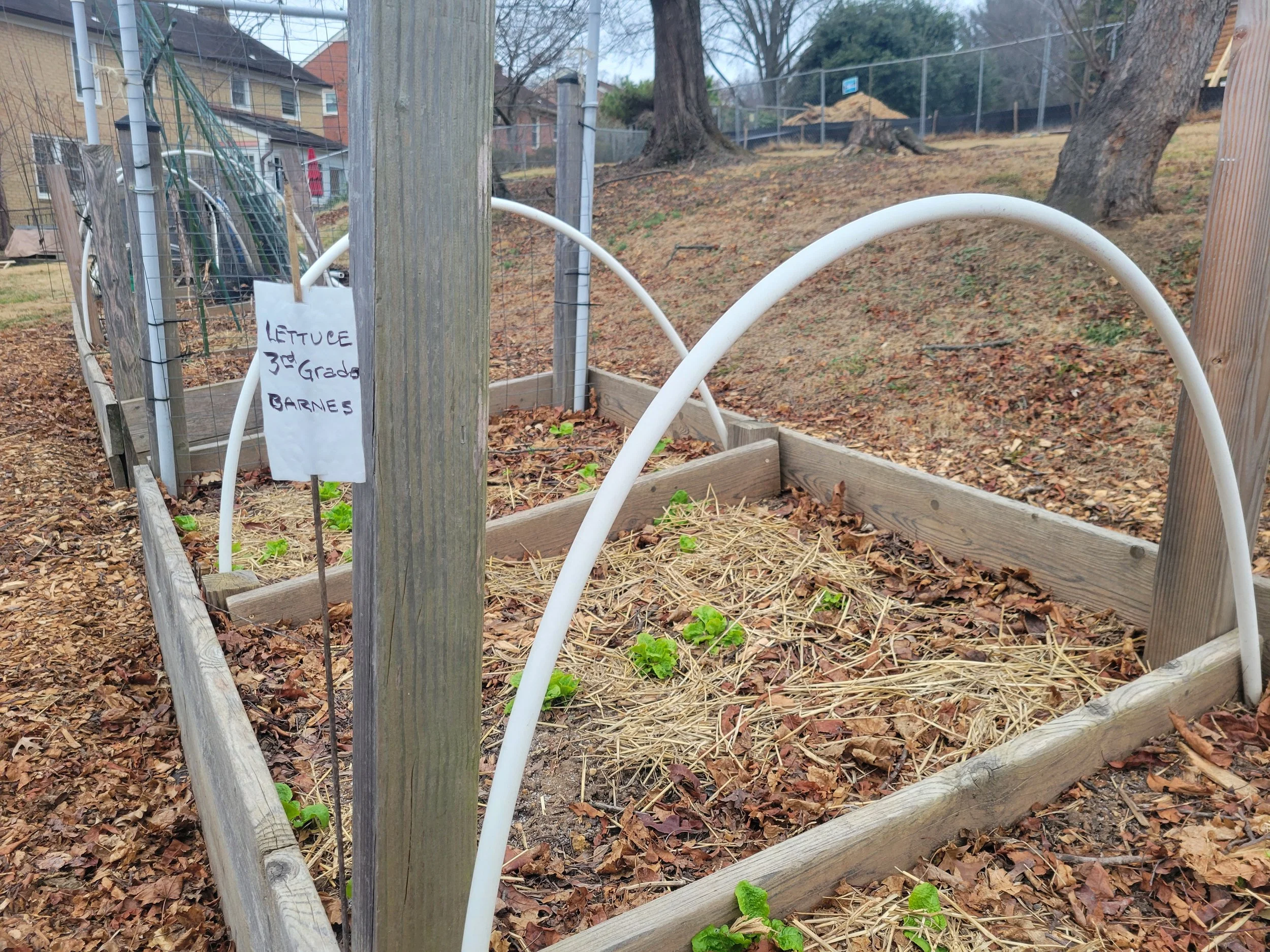
Lettuce growing in January.
Yes, it’s cold outside, but cool-season crops, if insulated from the extremes can flourish.
In a previous post, I argued that maintenance is a mindset. Here, I’m beginning to explore what that means in practice for school gardens.
I’m currently converting my own urban yard into a food forest, and one early decision comes to mind: I left a three-foot-wide strip of lawn adjacent to the sidewalk as lawn. Why? Two key reasons – dogs and snow. My neighbors walk their dogs along that sidewalk, and the dogs sniff, pee, and poo. Rather than waging war to keep their pets out of my plants/garden bed, I left 3 feet of lawn for them to do their business. And when it snows, we have space to pile the shoveled snow, and not damage plants underneath. 3 feet is the width of two (maybe three if your teenager is doing the job) swipes of the lawnmower.
The result is a space that works for multiple users (2- and 4-legged), reduces conflict, and makes maintenance easier. It also creates a clear cue to care – something that’s critical for the adoption of non-traditional landscapes.
That experience helped me articulate what I’m calling, for now, a maintenance mindset.
Maintenance is often framed as a burden – chores to be avoided if possible. But I’m beginning to see it differently. Living systems thrive through ongoing care, observation, and adaptation. Tending is as valuable as building.
Some early characteristics of a maintenance mindset include:
Stewardship –shifting from ownership to caretaking
Acts of attentiveness – watering, mulching, weeding, and integrated pest management as forms of slowing down and noticing
Reading signals – seeing stressed plants or compacted soil as information, not failure
Seasonal alignment – work with cycles (like a school year) instead of against them
Rhythms over rescues – 15 minutes a day to perform small, consistent actions is far better than sporadic heroic efforts
Partnership with nature – letting ecological processes do some of the work
Applied to school gardens, this mindset suggests a different set of priorities: planting, tending, and harvesting while students are present; using the summer to build soil health; investing in perennial fruit shrubs and trees; and designing gardens that don’t depend on extraordinary effort to survive.

With cold frames, thoughtful design, and cold-hardy crops, school gardens can produce nutrient-dense, fresh produce - radishes, spinach, peas, collard greens, Swiss chard, kale, broccoli, cabbage, carrots, beets, onions, and garlic – during the school year itself.
I’m still working through what this could mean in practice. I’m increasingly convinced that sustainable school gardens don’t require more commitment from students, families, teachers, and neighbors – they require a different way of thinking about maintenance.
What might become possible if school gardens were designed to rest when schools rest – and to grow when students are present to tend them?